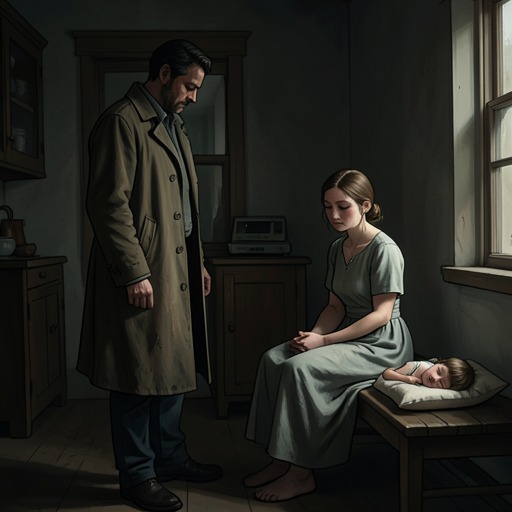
Joe Gargery
Great ExpectationsJoe Gargery is Pip’s brother-in-law, a blacksmith, and the story’s most enduring example of kindness without social display. Though he is described as foolish and uneducated, his strength is matched by tenderness: he welcomes Pip to the forge as a child, accepts his departure without demanding payment, and ultimately saves him from debt. Pip’s changing regard for Joe traces the cost of his class ambitions, while Joe’s steadfast affection survives estrangement, shame, illness, and loss.
Identity and Background
Joe is married to Pip’s older sister, Mrs. Joe Gargery, and works at the forge adjoining their wooden home. Pip’s first impression of the couple is that his sister must have made Joe marry her by hand. Against her forceful manner, Joe appears mild, good-natured, sweet-tempered, and easy-going. His fair face is framed by flaxen curls, and his undecided blue eyes seem almost mixed with their own whites. The narrator compares him to Hercules in both strength and weakness: a physically formidable man whose gentle nature is not a pose but a defining trait.
Joe’s childhood helps explain his sympathy for the vulnerable. While thoughtfully raking the fire, he tells Pip that his father drank and beat both Joe’s mother and Joe, and that his father’s blows against the anvil were less vigorous than those against his family. Joe relates this violence without turning it into a claim on Pip’s pity. His recollection instead places his own kindness in contrast with the cruelty he endured, and suggests why he recognizes a frightened child’s need for protection.
Joe has no formal education and struggles with reading and writing. His speech is marked by dialect, and in company he can become uncertain about how to address Pip. Yet his lack of schooling is not a lack of judgment or feeling. The novel repeatedly lets his care emerge in simple, concrete actions rather than polished declarations, making his moral authority independent of the social accomplishments Pip learns to prize.
A Childhood Bond at the Forge
When Pip returns from the churchyard to the house, he finds Joe alone in the kitchen. The two are fellow sufferers under Mrs. Joe’s authority, and Joe receives him as a confidant. Their bond begins in this shared vulnerability: Joe does not treat the child merely as an apprentice or an inconvenience but as a companion whose fears and secrets deserve trust.
Joe later recalls that, when he offered to court Pip’s sister and marry her, he asked that the poor little child be brought along. He promised there was room for Pip at the forge. The recollection establishes that Joe’s welcome preceded Pip’s ambitions and was part of the life he intended to build. For Pip, the forge is at once a home and a place of safety, though he will later come to feel ashamed of its soot, work, and working-class associations.
The friendship is reciprocal rather than simply protective. Joe and Pip look forward to working together as apprentices, expecting the shared business to lead to fun. Joe says that if Pip had objected to the forge because of its blackness and soot, he would have listened. His readiness to honor even a child’s objection shows how little he relies on authority to secure affection. Pip’s later departure therefore wounds Joe not only by taking an apprentice from the forge, but by breaking a future the two had imagined together.
Pip’s Departure and Joe’s Dignity
When a representative offers to cancel Pip’s apprenticeship indentures, Joe is asked whether he would object or require compensation. He gives Pip his freedom without asking for money. In response, he lays a hand on Pip’s shoulder with a tenderness the narrator likens to a woman’s touch. The gesture condenses Joe’s characteristic combination of strength and gentleness: the same hand that belongs to a powerful blacksmith can touch with exquisite care.
Joe welcomes Pip’s good fortune, but refuses the idea that money could make up for losing the child who came to the forge and became his best friend. The exchange makes the emotional cost of Pip’s advancement explicit. Joe does not obstruct it or make Pip feel guilty for accepting it; he simply makes clear that affection cannot be priced as a severed apprenticeship can. Pip leaves with the freedom to pursue a new life, while Joe remains at the forge with the loss of their shared daily companionship.
Years later, Joe visits Pip in London to tell him that Estella has returned to Satis House and would be glad to see him. In Pip’s fashionable surroundings, Joe’s awkwardness about address becomes conspicuous: he calls Pip “Sir” when formality overtakes him and “Pip” when affection returns. Reporting Miss Havisham’s message, he even distinguishes his marriage vow from his present assurance to Pip, revealing the effort with which he tries to navigate a world whose conventions are alien to him.
When Pip and Joe’s eyes meet, the formality disappears and Joe gives him his hand. He touches Pip gently on the forehead before leaving. Pip recognizes the simple dignity in him and rushes after him, but Joe has already gone. The scene reverses their earlier intimacy: the bond remains, but Pip’s shame and social distance have made Joe’s visit a moment of painful departure rather than easy companionship.
Care, Loss, and Reconciliation
At Mrs. Joe’s funeral, Joe sits apart at the upper end of the room, assigned the place of chief mourner. When Pip bends to speak to him, Joe begins to recall that Pip knew his sister when she was a fine figure of a woman, then clasps Pip’s hand and cannot continue. His grief is restrained, but the unfinished sentence and the clasp convey the weight of a shared household and a difficult marriage now ended.
In the account of Mrs. Joe’s final days, Joe is summoned from the forge when she regains speech after a long period without words. She asks through signs for him to sit close and for her arms to be placed around his neck. Resting her head on his shoulder, she says his name, then “Pardon,” and once “Pip”; she dies an hour later. The scene gives their marriage a quiet tenderness at its end, without erasing the harshness that had marked their home. Joe’s presence at her bedside is the final intimacy she seeks.
After the funeral, Pip watches Joe working at the forge before leaving early in the morning. The glow of health and strength on Joe’s face suggests a life continuing in the place Pip has chosen to leave. Pip asks to keep Joe’s blackened hand rather than have it wiped clean, and promises that he will come down soon and often. The soot, once among the signs of commonness that helped alienate Pip from home, becomes an object he wants to preserve as the mark of Joe’s labor and their bond.
That promise is not fulfilled as easily as Pip intends. Later, as Pip imagines the consequences of his possible death, one of his sharpest fears is that Joe and Biddy will never know how sorry he had been or how faithfully he had meant to act. The thought reveals how deeply their judgment matters to him, even after he has spent years away. His anxiety is not only about dying but about leaving a false account of himself in the memories of the people who loved him.
During Pip’s grave illness, Joe nurses him back to health. When Pip wakes after recovery, he finds Joe beside him, his head on the pillow and his arm around Pip’s neck, overjoyed that Pip recognizes him. The tenderness echoes the earlier touch on Pip’s shoulder, but now the roles of caretaker and dependent have been reversed. Joe’s affection has survived Pip’s long estrangement without requiring him to earn a welcome back.
Joe also settles the debt and costs on which Pip had been arrested. Pip initially assumes that proceedings have been withdrawn or suspended while he recovers; he discovers instead that Joe has paid the money, with the receipt in Joe’s name. Joe has acted without turning rescue into a demand for gratitude or a public reckoning. His practical generosity restores Pip’s immediate freedom while confronting him with a moral debt that cannot be measured by the amount paid.
Marriage, Forgiveness, and Narrative Significance
Joe and Biddy marry, and Pip learns the news directly from Biddy, who announces that it is her wedding day and she is married to Joe. The marriage gives Joe a renewed household and companionship after the death of Mrs. Joe. Pip’s response is shaped by his earlier wish to confess everything to Joe: when he gets up intending to tell him all, Joe has already departed, leaving only the evidence of his quiet care behind. Their parting is not a rejection; it is a consequence of Joe’s independent life and of the timing of Pip’s belated return to honesty.
When Pip visits them later, Joe welcomes him without reproach. He tells Pip to abide by his words and not dwell on the small childhood matters that had once been kept secret out of fear of punishment. Joe says Biddy had taken trouble to help him understand it that way, then turns from judgment to hospitality, insisting that Pip eat and drink. His reasoning may be awkwardly expressed, but its moral direction is clear: old injury should not be made an obstacle to care in the present.
Joe’s forgiveness is equally plain. When Pip asks whether he is forgiven, Joe answers that God knows he forgives him, if there is anything to forgive. The qualification is not a disguised accusation; it reflects Joe’s reluctance to keep score. By refusing to magnify Pip’s failures, he makes reconciliation possible without demanding that Pip first master a speech of repentance.
As a character, Joe is recognizable in his steady generosity, yet the range of his responses gives that constancy depth. He can be shy and awkward in London, formidable in strength, tender in touch, wounded by separation, overcome by grief, and resolute in forgiveness. His contrast with Pip’s changing ambitions is not simply that one man remains poor while the other seeks gentility. Joe’s conduct supplies the standard by which Pip’s social aspirations are tested: education, money, and polished manners cannot substitute for loyalty, humility, or the ability to care for another person.
The novel’s first-person recollections make Joe’s moral importance inseparable from Pip’s retrospective judgment. As a child, Pip knows him as a fellow sufferer and friend; as an aspiring gentleman, he grows ashamed of him; after loss and illness, he recognizes the loyalty that his pride had obscured. Joe does not have to become a gentleman for Pip to see his dignity. The lasting force of their relationship lies in the difference between Joe’s unchanging welcome and Pip’s repeated departures—and in the fact that Joe is there to welcome him again.